If you find this newsletter valuable, consider sharing it with friends, or subscribe if you haven’t already 👇
Q: My company is constantly going through reorgs. It stresses me out. Partly because I can never feel fully settled, and partly because I feel like I should be taking advantage these opportunities to move ahead in my career. Any advice?

One of my co-workers at Airbnb liked to joke that if she’s been sitting in the same seat for more than six months, something was about to change. And she wasn’t wrong.
Reorgs are a way of life at fast-growing startups, and if you ask me, they’re a good thing. Competitors make moves, markets shift, and new information emerges. It’s important for your business to adapt. Would you rather your company just keep doing what it’s been doing because it’s easy? I wouldn’t.
On an individual level, as you suggested, reorgs are a great opportunity to take a step forward in your career. Some of the biggest jumps in my own career have come as a result of reorgs. The changing team structures often unlock new opportunities, new leadership roles, and if nothing else give you a chance to take on more responsibility. So it’s wise to think ahead.
First, let’s talk about how to set yourself up for success ahead of a reorg tactically (if that’s something you’re looking for), and then how to survive these constant changes emotionally.
Making the most of reorgs 🧗♀️
Here are five tactical ways to give yourself the best shot at leveling up when a reorg happens:
1. 💪 Deliver impact: This is going to sound obvious but good things happen to those who do great work. You’ll only be considered for bigger roles if leaders believe you will succeed in those roles. So always come back to this: Spend the majority of your energy doing great work and delivering results. Everything else below is secondary. 2. ✋ Make know what you want: When new teams and initiatives are being planned, there will be a discussion about who the leaders should be. Unless these people know you that are interested in that type of role, you won’t be considered. So, make it known. Early and often. Bring it up in your next 1:1. 3. 🤔 Anticipate the change: In the back of your mind, always try to predict where things are heading. Think, if I were in charge, what would I change? Then, use that to inform your planning. This may mean developing a new strategy just in case, adjusting your current roadmap, or engaging with someone who is likely to be your new boss. If you do this well enough, and end up solving the problem that the re-org would have tried to solve, it may result in no change having to happen at all (a good thing!). 4. 🤗 Embrace the change: When a re-org is imminent, in most circumstances, the last thing you want to do fight the change. Change is scary, but change is good. Especially if this is a 2-way-door type of change. If you feel strongly that the new direction is a mistake, make your thoughts known, express your concerns clearly, but be ready to disagree and commit. It’s critical that you accept the new reality, and then do your darnedest to make it successful. You want to be the person who’s making the shift successful, not the person constantly complaining. 5. 🏋️ Create the change: Ultimately, where you want to be as much as possible is being the person who recognizes that change should happen, figures out a plan to make it happen, and then makes it happen. This is what being a senior leader is all about. Instead of just complaining about how badly things are working, be the person with a concrete proposal for how to fix it. Help your team and company become better, pro-actively, before you are asked to.
Now, let’s look at how to survive reorgs, and the constant change they bring, emotionally. For this section, I reached outa former executive coach of mine, Katherine Hosie (who you may recognize from this post about overcoming impostor syndrome), who helped me work through some big changes in my life. Katherine generously agreed to share her perspective, which you’ll find below.
Surviving reorgs, emotionally 😰
First of all, you’re experiencing a common and frustrating challenge.
You’re also bumping up against your next growth opportunity.
As the Zen proverb goes, the obstacle is the path. You’re learning to embrace constant change, which will become hugely valuable in your career. Below I’ll share how to make sense of your situation, why you need to cultivate good habits right now, and finally five ways to become more adaptive, resilient, and even grateful this is happening.
1. Here’s how to think about change
What you’re experiencing going through constant reorgs is known as an “extended transition.” William Bridges wrote several books on the topic including [Transitions](https://www.amazon.com/Transitions-Making-Sense-Lifes-Changes/dp/0738285404/?crid=J0HJCWVZDFV6&dchild=1&s=books&sprefix=transitions+%252Cstripbooks%252C209&sr=1-1), and [Managing Transitions](https://www.amazon.com/Managing-Transitions-25th-anniversary-Making/dp/0738219657//143-5986329-9347703?_encoding=UTF8&pd_rd_i=0738219657&pd_rd_r=746b0392-ac96-40fa-8a01-fdec1bc407ee&pd_rd_w=bNgqS&pd_rd_wg=lmCdU&pf_rd_p=4e3f7fc3-00c8-46a6-a4db-8457e6319578&pf_rd_r=QVJN41DKZJ5S6ARRB6Q4&psc=1). He teaches that during any transition, we are in one of three stages:
1. *Ending 2. Neutral Zone 3. New Beginning*
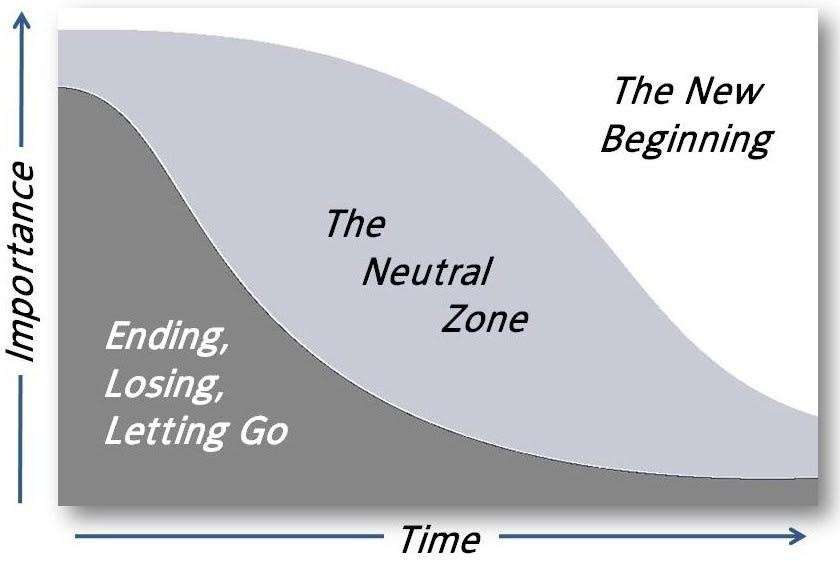
You’re currently in a prolonged Neutral Zone. This can lead to what I call, “transition fatigue.” That feeling of “how long is this going to last…?” It’s tough to be in that space of uncertainty, and even tougher if your role is to lead others through the everlasting wilderness.
2. Why you need to cultivate good habits right now.
“We are what we repeatedly do. Excellence then is not an act but a habit.” — Aristotle
The solution for navigating the Neutral Zone is cultivating good habits. Why? When your destination is unclear, bold steps forward are often counterproductive and erroneous. Good habits on the other hand will give you the sense of clarity, control, and progress you require. By putting healthy new habits in place to (1) reduce your stress, (2) get in integrity with yourself, and (3) progress your career, you will feel stronger, more in control, and you will grow. Being in the Neutral Zone is perfect time to build these habits. (Recommended reading: [The Slight Edge](https://www.amazon.com/Slight-Edge-Turning-Disciplines-Happiness/dp/1626340463/?cv_ct_cx=the+slight+edge&dchild=1&pd_rd_i=1626340463&pd_rd_r=2c4cbb61-904f-42c9-bb26-ef5d646e8dad&pd_rd_w=1CNwb&pd_rd_wg=6Qx79&pf_rd_p=1da5beeb-8f71-435c-b5c5-3279a6171294&pf_rd_r=WJ142AHRXM9JPFSMCWKW&psc=1&sr=1-1-70f7c15d-07d8-466a-b325-4be35d7258cc) and [The Compound Effect](https://www.amazon.com/Compound-Effect-Darren-Hardy/dp/159315724X/?dchild=1&s=books&sr=1-2))
3. Five ways to become more adaptive and resilient
With habits in mind, let’s draw from the [Four-Factor Model](https://static1.squarespace.com/static/56f581f83c44d8fc598bccbf/t/570ef3e0a3360c226a32ffde/1460597729733/Cavanagh-2012-The+Coaching+Engagment+in+the+21st+Century+.pdf), developed by Dr. Michael Cavanagh, University of Sydney, who’s an expert on leading through complexity. Cavanagh’s four factors are Perspective, Purpose, Dialogue, and Mindfulness, which I’ll explain below. I’ll also touch on a fifth factor that I’ve found to be valuable — humor.
i. Perspective
It’s normal to become myopic when stressed, when what’s actually required is perspective. This includes perspective on time ("this too shall pass”), knowledge, and context. How frequently are you stepping outside your office, city, state, or country? When was the last time you attended a conference? How are you growing your network? How are you learning? Reading widely, including history, increases perspective. I know of someone that would periodically meet recruiters to stay abreast of what kept them marketable. Stepping out to gain perspective and bring that wisdom back into your role is adaptive. Regarding time, how far out are you looking? Think less tree, more forest. Are you even in the right forest? Which bring us to the second factor…
ii. Purpose
Purpose is the set of criteria by which you judge the degree to which you’ve achieved something of value. What is the primary purpose of your role, your team, your organization? Your career? Whilst goals and direction can thrash, purpose creates a stability that endures. It’s possible, through dialogue, to create a shared purpose for your role and your team, and a primary leadership responsibility is to help others make meaning. Step back and ask yourself: what matters most to me? Regular self-reflection will help you re-orient or double down on what you are doing and why. Building habits to keep shared purpose front and center (e.g. referring back to it at the start of every team meeting) is centering, which brings us to the third factor…
iii. Dialogue
One thing that consistently creates safety, reduces stress, and increases context is relationships. In an increasingly VUCA world, sharing perspectives and the burden of decisions with others will lighten your load. Knowing that you are not alone is potent, and complex problems require shared intelligence. Also, new opportunities emerge through relationship. It’s also wise to be looking for ways to “mend the net,” ensuring all relationships, within and across teams, are strong. For example, setting up recurring social dinners with a challenging peer once a quarter to reduce stress on the relationship, or initiating bi-weekly triad lunches to increase organizational awareness where you invite one person and ask them to also invite a valued colleague. I call these “invite a stranger lunches”, and they’re a fast way to grow a smart, connected network that will increase future opportunities.
iv. Mindfulness
Mindfulness is your capacity to dispassionately notice what is happening, as opposed to seeing life through your filters, fears or desires, e.g. noticing the subtle anxiety that drives your decisions and behavior. Mindfulness has now become table stakes. A habit around this could be starting a sustainable meditation practice of ten minutes per day. Other options include regular exercise, sleep hygiene, journaling, whatever helps you slow down enough to notice your reactions, assumptions, and fears in the moment. These can be built into how you lead others. I regularly work with a high-functioning organization that has meditation built into the start of every team meeting. Tracking these habits increases your agency and motivation. They may seem like a small things to work on, but I guarantee they will pay dividends and you will show up differently.
My final recommendation is:
v. Humor
I believe one of the most important things we can have in life is a sense of humor. The word “humor” has the same root as “humus” (earth), “human”, and “humility.” Having a sense of humor about ourselves and life grounds us, makes us more human and connected, and humbles us. Humor helps us relax, become more creative, absorb new ideas and learn better. It grants us acceptance that things are as they are, which serves as a springboard for change. So it’s worth asking how you can inject humor into your life and your work. I’m remembering two wonderful clients, in different sessions, that I was laughing with in the past. One was comparing how they felt with the old movie “Office Space”, and another with“High Anxiety”. Humor in those moments brought lightness and moved us forward more quickly.
Ask yourself: If constant ambiguity is the new norm, what kind of habits will serve me now? And how will I also lead others in becoming more open? None of these things done in isolation will do much, but done consistently they will change a lot for you. So think habits, not actions. An action will get you so far, but a smart adaptive habit can fuel you forever. As you know, habits become character, and character is destiny.
On a light note, here’s some final great advice from Bruce Lee. He deeply understood constant change and evolution and his philosophy is now more valuable than ever. The rigor of Lee's daily discipline and continuous improvement allowed him to let go and flow. Your new habits around perspective, self-reflection, relationships, mindfulness - and humor, will help you do the same.
[Watch on YouTube](https://www.youtube.com/watch?v=0EygqL--RW4)
Be water, my friend.
You can learn more about Katherine Hosie at [www.Powerhouse-Coaching.com](https://www.powerhouse-coaching.com/), or by emailing her at [katherine@powerhouse-coaching.com](mailto:katherine@powerhouse-coaching.com).
Inspiration for the week ahead 🧠
1. Watch: Ten Meter Tower (via Polina Marinova)
2. Watch: The Astounding Physics of N95 Masks
3. Listen: John Collison – Growing the Internet Economy on Invest Like The Best podcast (or read the summary notes here)
If you’re finding this newsletter valuable, consider [sharing it with friends](https://www.lennyrachitsky.com/), or subscribing if you aren’t already.
Sincerely,
Lenny 👋