🔐 This is a preview of a subscriber-only post🔐
Consider subscribing if you’d like to receive this, and much more, in your inbox weekly.
Q: How do you think about setting goals for your team (and company)?
As a leader, one of your most importantjobs is to make sure everyone is moving in the same direction — channeling all of their energy, focus, and resources towards the same outcome.
That's exactly what goals are for.
Goals are a tool to help you align and motivate everyone on your team to successfully achieve a desired outcome. Below, I share a framework that I’ve used to set goals and institute them across an organization.
Why set goals?
Let’s start by thinking about where goals fit into the bigger picture:
Mission → Vision → Strategy → Goals → Roadmap
You start with your Mission (what are you trying to achieve), which informs your Vision (what does the world look like when you achieve it), which then leads to your Strategy (how you plan to get there).
What comes next? You need to find a way to tell whether you're successfully executing your Strategy (and thus your vision and mission). That's where goals come in.
Let's look at Tesla:
- Mission: Accelerate the world’s transition to sustainable energy
- Vision: Create the most compelling car company of the 21st century by driving the world's transition to electric vehicles
- Strategy
- Build a sports car
- Use that money to build an affordable car - Use that money to build an even more affordable car - While doing above, also provide zero-emission electric power generation options
How does Elon know whether Tesla is successfully executing this strategy? GOALS!
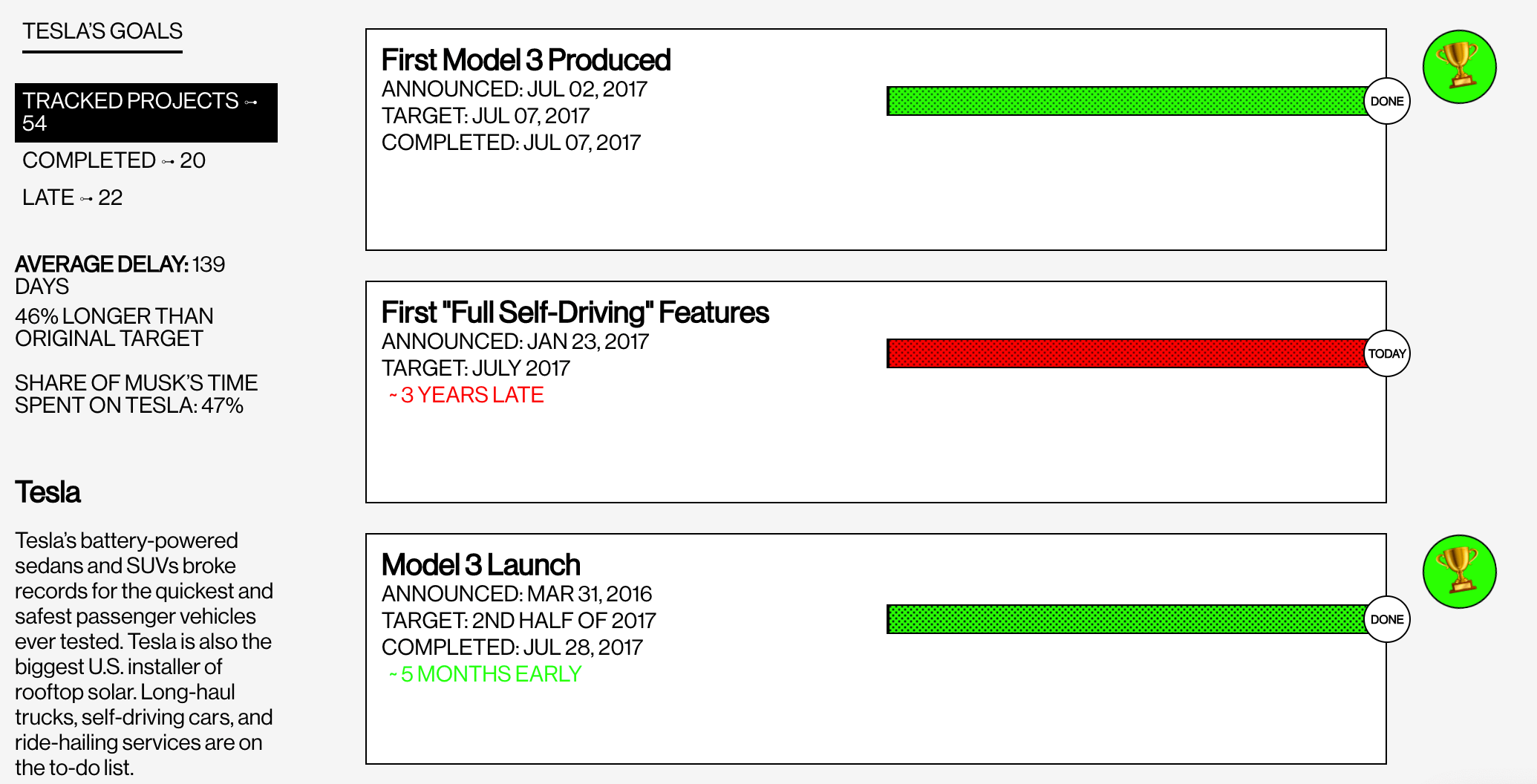
Goals have three primary benefits:
1. Clarity: You know what success looks like 2. Alignment: All team members know what success looks like 3. Motivation: A push to achieve more than you would have otherwise
I want to highlight one of the biggest traps I see leaders fall into: assuming that everyone on their team is aligned on what success looks like. The metaphor I like to use for this (inspired by a former colleague) is a silver burrito. Like the ones you see on the Chipotle billboards:

That burrito looks delicious because we’re all picturing our favorite burrito inside the silver wrapping. Yum! Similarly, projects often look delicious to team members because they're each imagining different goals — goals that they are personally most excited about (e.g. increase conversion vs. make users happier vs. refactoring code). A product leader’s job is to unwrap the burrito and make sure everyone is seeing the same thing. Let’s talk about how to do that.
How to set goals
Now that we know a goal is just a way to understand whether you’re achieving your strategy, let’s talk about how to decide what the actual goal should be…